
Gary Previous Residents by Era
No single roll gives a complete line of people tied to one Gary address. Current county systems identify a parcel and title holder, recorded deeds carry the ownership trail backward, and selected city directories connect names with street numbers. Census schedules add household detail only in released years. Maps establish where the lot and structure stood. Together, these sources separate past residents from owners, heirs, lenders, permit applicants, and other names that may touch the property without living there.
| Gary source | Known span | Access point | Evidence it adds |
|---|---|---|---|
| Assessor parcel card | Sample history 2002–2025; full cutoff unknown | Lake County XSoft | Owner, situs and mailing addresses, legal description, values, and improvements; not all occupants |
| Recorder deeds | Online start unknown; record books exist | Recorder portal and counter | Grantor, grantee, instrument, date, and legal description |
| Gary city directories | Selected years from 1908 through 1973 | Gary Public Library and Indiana State Library | Names listed at an address, with gaps between volumes |
| Federal census | Public schedules through 1950 | National Archives and library databases | Household members and relationships on one census date |
| Sanborn and city maps | Gary/Miller, 1907–1951; local maps, 1911–1915 | Indiana State Library | Building, lot, block, street number, and use, usually without names |
| Permits and probate | Online or archive starts not confirmed | Gary Building and Lake County Clerk | Work at the address, estate parties, and trail endpoints |
For recent years, save the parcel number and legal description first. For an early or mid-century search, ask for the closest directory volume and match its street listing to a dated map. The Gary city directories are covered in depth on their own page; here they serve as dated stops in one address trail.
Anchor Gary Address Records
The free Lake County Assessor XSoft search accepts an owner, address, or property number and needs at least three characters for suggestions. Save the Property ID, owner name, situs address, mailing address, legal description, transfer history, and improvement fields. The situs is the physical parcel address. The mailing address is where tax correspondence goes, so it may point elsewhere and must not be treated as proof of residence.
The county sample at 400-26 Broadway shows why this matters. It has a Gary situs but a Crown Point mailing address because the parcel is county owned. Its legal description names Gary Land Company’s first subdivision, while the parcel ID hands the search to GIS and recorder links. A search for previous residents should preserve all of those labels. The legal description is often more durable than a street number.
- Legal description
- The recorded lot, block, subdivision, or land description that identifies the property apart from its postal address.
- Situs address
- The street address where the parcel is physically located.
- Parcel ID
- The county identifier used to connect assessor, GIS, recorder, and tax records.
Gary Recorder Search Needs Fallbacks
The official Lake County Recorder search advertises Search and Advanced Search, but the public route redirected to a member login during research. It showed username, password, registration, and password-recovery controls without exposing grantor, grantee, date, document type, book/page, image price, or the first online year. An empty public screen does not mean that an old deed is gone.
Call 219-755-3730 or visit Building A, second floor, 2293 N. Main Street in Crown Point, Monday through Friday from 8:30 a.m. to 4:30 p.m. A written request should name the parties already found, parcel number, legal description, likely document type, date range, and desired copy type. Ask about older books and the Book Scanning Project.
The Lake County Recorder page pictured here explains the office’s records and counter route.
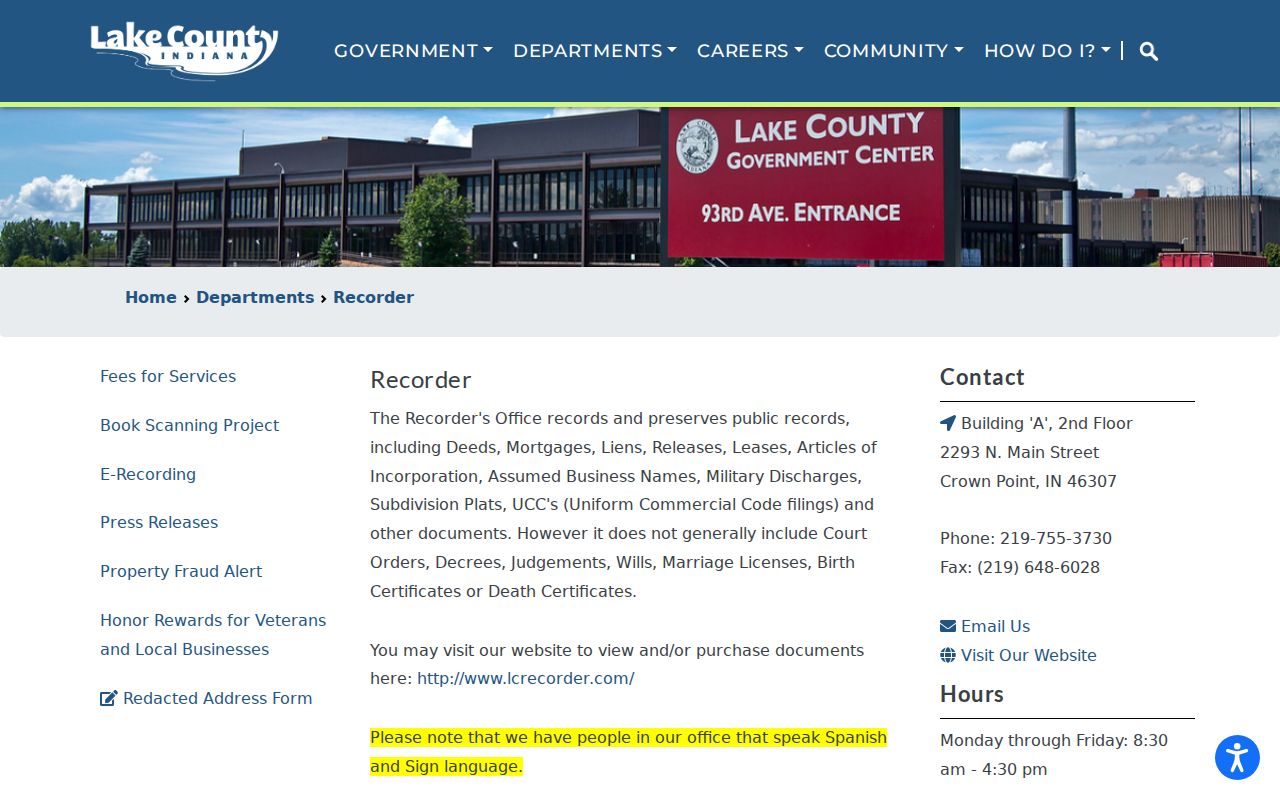
The counter and phone are essential fallbacks when the member screen cannot carry the deed chain farther.
Trace Gary Previous Owners
A chain of title is the ordered line of recorded transfers for one property. Work backward from the present owner, but match each transfer by legal description as well as name. Trusts, business entities, alternate spellings, and “et al.” can break a name-only search. A deed proves a title transaction, not that each named party lived at the address.
- Pull the current owner, parcel ID, and full legal description from the assessor or GIS record.
- Use the parcel’s RecorderLink or ask staff for the deed that transferred title into that owner.
- Record the grantor, grantee, recording date, document number or book/page, and legal description.
- Search the prior grantor as a grantee, then confirm that the earlier instrument describes the same land.
- Repeat until the online trail stops, then use the recorder’s books, scans, counter, or a targeted records request.
- Grantor
- The party transferring an interest in the recorded document.
- Grantee
- The party receiving that interest. Search a seller here to find an earlier purchase.
- Chain of title
- The linked sequence of recorded transfers for the same land.
Map Past Gary Resident Addresses
Old and modern street numbers should never be assumed to identify the same parcel. Gary’s framework uses west-of-Broadway number forms, and official maps preserve subdivisions, lots, blocks, streets, and building numbers. Research did not verify one citywide renumbering year or a full conversion chart. Bridge an uncertain address with its direction, former street name, subdivision, lot and block, parcel ID, legal description, and map year.
Sanborn fire-insurance maps for Gary and Miller cover editions from 1907 through 1951. They show building footprints, materials, uses, doors, windows, lot lines, and house numbers, but generally no resident names. Northern Lake County maps from 1911 and 1912 and a 1915 Gary city-engineer map can tie the old block to today’s parcel.
The Indiana State Library Sanborn list pictured here identifies the Gary and Miller map runs.
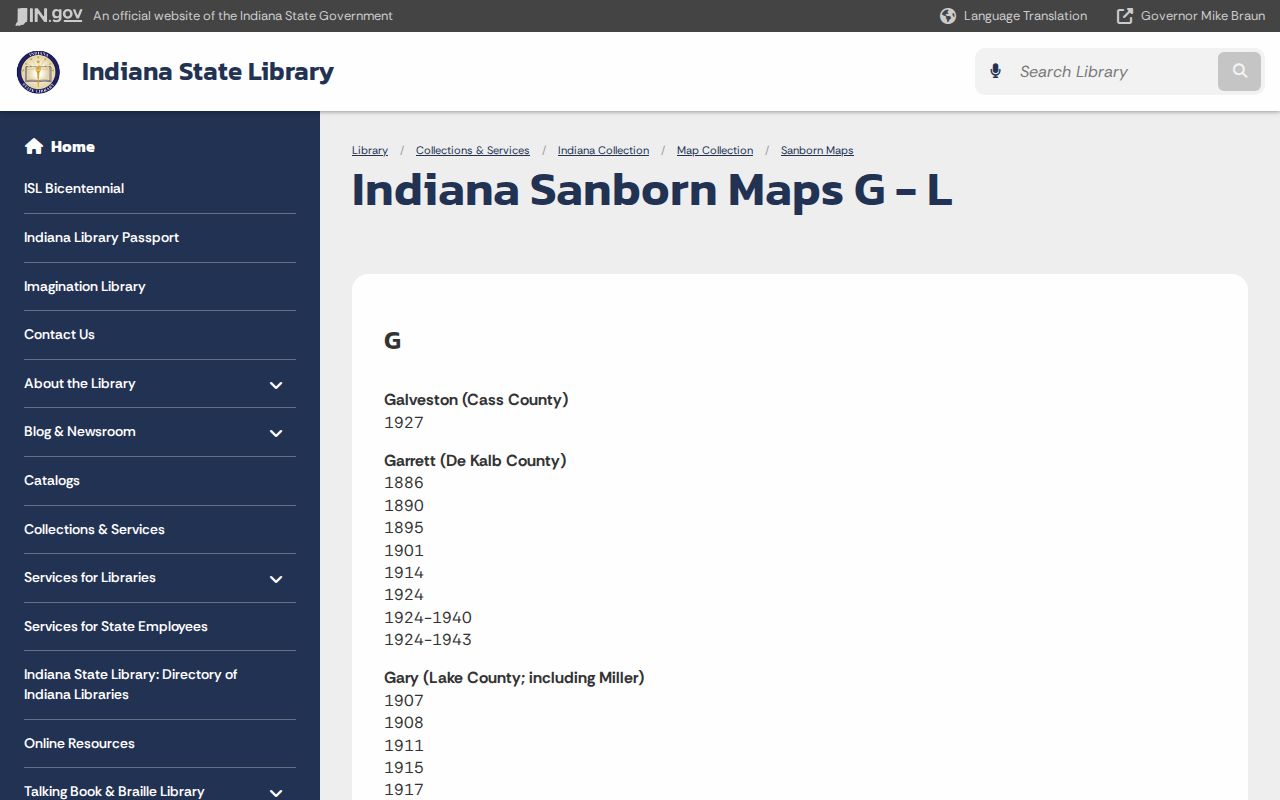
Use a map sheet to prove the structure and number, then use a directory or census record to test who was listed there.
Gary Archives Extend Resident Trails
The Gary Public Library Indiana Room combines directories, maps, yearbooks, newspapers, obituaries, microfilm, photographs, government documents, and on-site genealogy databases. Its verified directory years begin in 1908 and run through 1960 with gaps. The State Library lists a different, complementary run reaching 1973. A reverse or criss-cross collection has not been confirmed, so ask staff for street sections, telephone books, supplements, and reverse volumes before claiming an address-to-person result.
IU Northwest’s Calumet Regional Archives adds the City of Gary Collection, CRA010, dated 1836–2015, plus county public-records, redevelopment, school-enumeration, and court-index collections. Give staff a narrow request: street number, name variants, date range, subdivision, and collection ID.
The regional archives collection guide pictured here opens the finding-aid route.
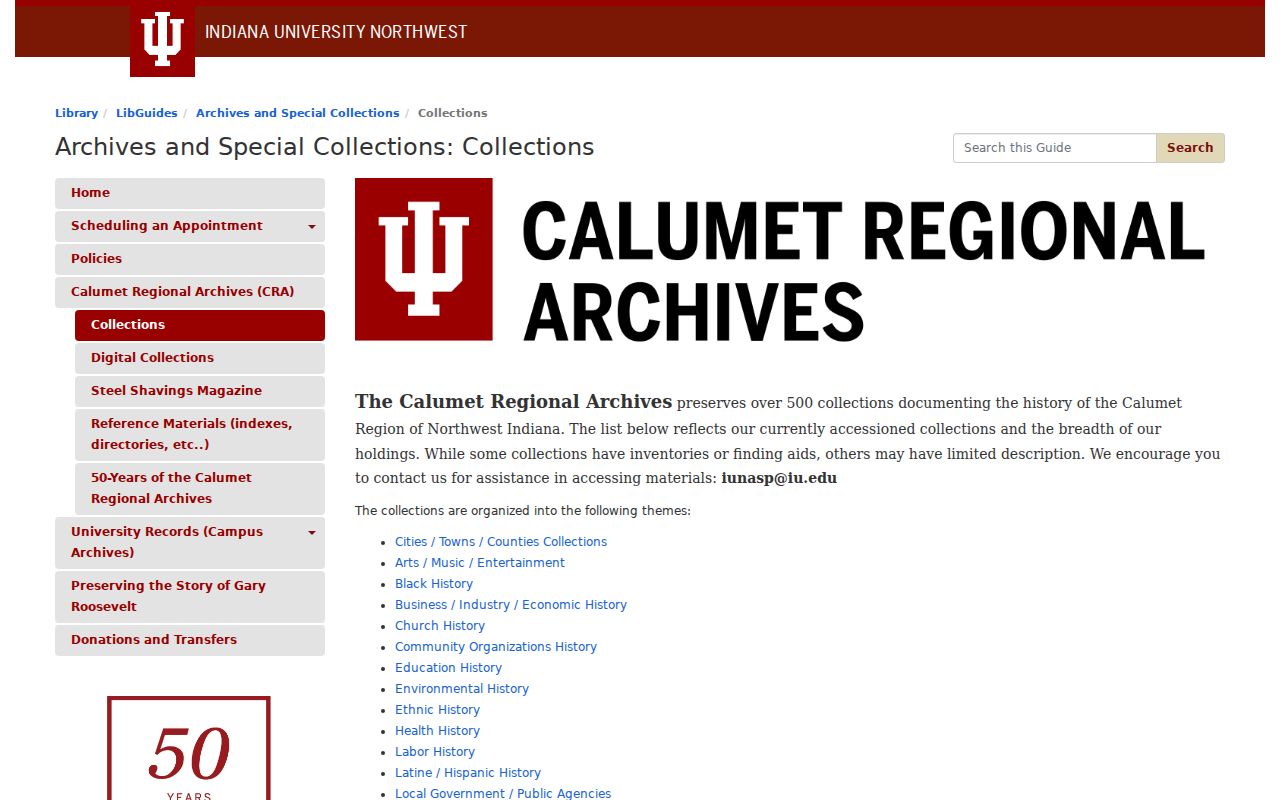
Archive boxes may preserve the bridge that neither a current portal nor a printed directory supplies.
Confirm Gary’s Past Households
Ownership is only one layer. A directory may list a person at the address in a publication year, while a released federal census may show a household on its enumeration date. An enumeration district is the area assigned to a census taker. Its streets and bounds may not match a modern parcel search. Pairing both sources can test previous residents without treating either as a live roll.
- Choose the closest Gary directory year and copy the entry exactly, including initials and address abbreviations.
- Locate the nearest released census schedule, through 1950, and identify the correct enumeration district and street.
- Compare names, ages, relationships, and address order, allowing for moves between publication and census dates.
- Check the next directory year, newspapers, and maps before deciding that a same-name person is the same resident.
Obituaries and death notices can connect past residents with relatives or a move. Probate records held by the Lake County Clerk may identify an estate, heirs, or property, though access varies. A notice is a lead, not a certified record. Follow Gary, Lake County, or state eligibility rules for certificate requests.
Lawful use. Research previous residents for Gary house history, genealogy, or estate work. Never use an old or current address to track, harass, or harm a living person.
What Gary Resident Records Prove
A sound address history labels every result by source and date. The assessor shows title-related current data, not a full household. GIS is current and is not a survey. A deed names parties to an instrument. A city directory records a publisher’s listing, and a census captures one official date. Permits can name an owner, applicant, contractor, or agent. Keep those roles apart.
Protected voter addresses, Address Confidentiality Program information, utility records, DMV addresses, sealed cases, and restricted vital records are not ordinary public sources. Property names and addresses may also be restricted for covered persons. Missing online material may exist at a counter or archive, but no authoritative source confirmed a Lake County courthouse fire, destroyed decade, or deed-imaging cutoff. Ask the custodian rather than inventing a loss.