
Gary Historical Directory Collections
Gary's directory shelf begins near the city's founding and continues in uneven runs. Two official inventories overlap but do not match year for year. Treat them as separate holdings lists, and confirm a volume with the institution before planning a visit.
| Collection | Years | Where held | Access |
|---|---|---|---|
| Gary directories in Ancestry | 1908, 1911, 1913, 1918, 1920, 1922, 1923, 1925, 1927, 1929, 1930, 1935, 1937, 1939, 1941, 1945, 1948, 1952, 1955, 1957-1960 | Gary Public Library Indiana Room | On-site database access |
| United States city-directory microfilm | Gary, 1908-1919; separate 1958 reel | Indiana State Library | Microfilm, call-number request |
| Polk's Gary City Directory | Selected volumes, 1918-1957; then 1959-1965, 1971, 1973 | Indiana State Library | Printed or library-held volumes |
| 1908-1909 catalog lead | 1908-1909 | Google Books catalog | Catalog record; readable pages not exposed |
| City of Gary Collection, CRA010 | 1836-2015 | IU Northwest Calumet Regional Archives | Finding aid and archive request |
The first directory title identified is from 1908. The latest State Library Polk holding listed is 1973. That does not mean every year between those dates exists, and it does not establish when all Gary directory publishing stopped.
Gary Directory Years in Context
Gary was founded in 1906 as a planned steel city. Its rapid growth helps explain why a directory title appears so soon and why later volumes are valuable for tracking new streets and a mobile population.
| Year | Gary records milestone |
|---|---|
| 1906 | Gary is founded within Lake County's older record system. |
| 1908-1909 | Earliest directory title found in the researched catalogs. |
| 1915 | City-engineer and Sanborn maps offer a same-era address bridge. |
| 1906-1939 | Gary Public Library's WPA Index covers names, streets, wards, houses, and civic topics. |
| 1973 | Latest Polk volume named in the State Library holdings guide. |
Population rose from about 2,000 in 1906 to 16,802 in 1910 and 55,378 in 1920. Directory spellings, initials, widow forms, and group affiliations matter in a city shaped by migration from Europe, the Black South, and Mexico.
Gary Directory Research Room
The Gary Public Library Indiana Room is the best local starting point. It asks visitors to make an appointment, generally Monday through Friday from 9:00 a.m. to 4:00 p.m. Contact staff at 219-886-2484 extension 315 or indigpl@garypubliclibrary.org. Ancestry Library Edition and African American Heritage are available only at the library.
Send a narrow request before visiting: surname and variants, approximate year, street, school, church, or organization. Ask whether staff can check a printed volume, yearbook, newspaper reel, obituary index, WPA heading, or map. That wording gives the librarian a defined shelf task and makes a gap easier to document.
Review the library's special collections overview before looking at the captured page below.
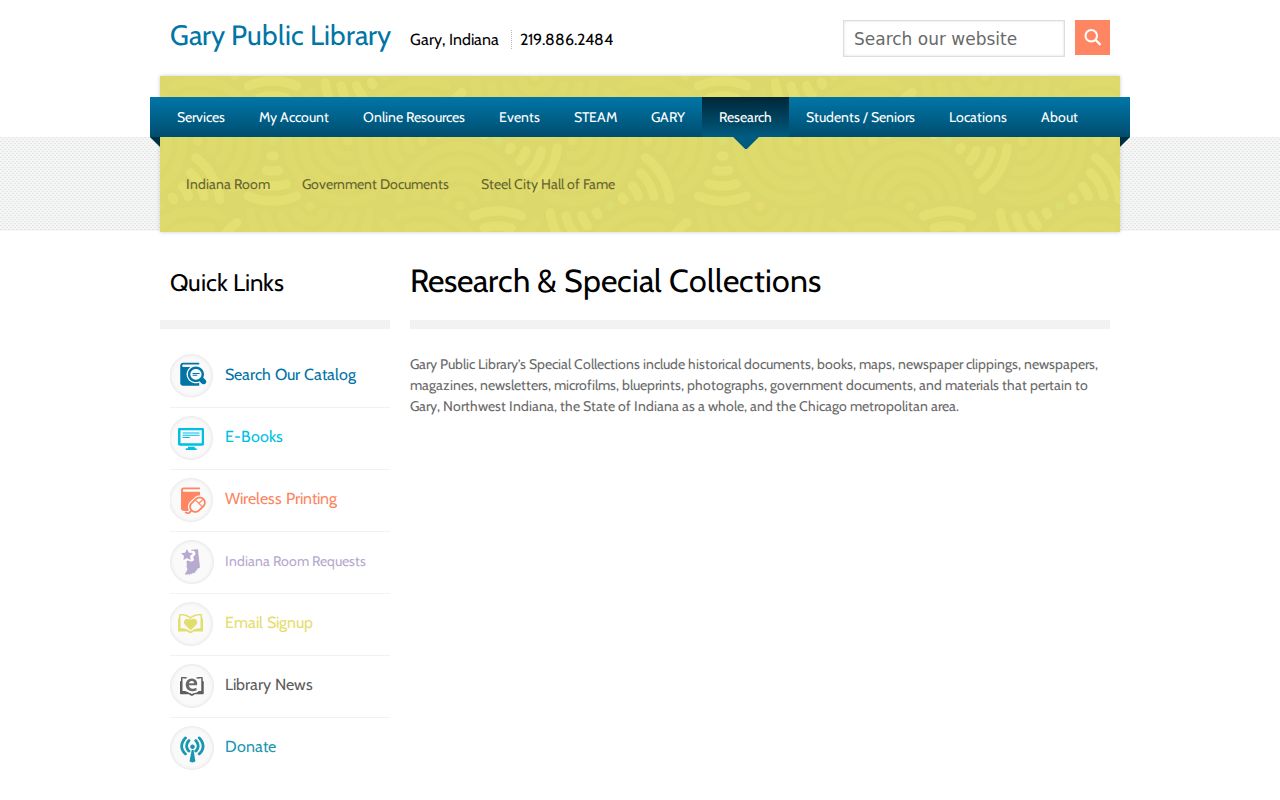
Note: An online catalog hit does not mean the volume pages are readable from home; confirm the actual access channel first.
Decode a Gary Directory Line
No readable entry page was exposed in the unattended catalog inspection. The field list below is therefore a checklist for examining a real Gary volume, not a claim that every edition printed every item. Start by photographing or transcribing that volume's key.
| Indexed name | Copy spelling, initials, title, and any widow or relation notation exactly. |
|---|---|
| Street line | Record house number, direction, street form, and any separate business address. |
| Work line | Note an occupation or business only when the printed entry supplies it. |
| Status marks | Use an owner, renter, phone, or boarding mark only when the volume's key defines it. |
| Cross-reference | Follow “see” entries, institutions, and alternate listings to their cited page. |
- Criss-cross directory
- A volume or section arranged by street or telephone number instead of surname.
- Householder index
- An address-order list of the principal person printed for each dwelling.
- Abbreviation key
- The publisher's legend that defines short forms and symbols used in that edition.
The Gary reverse-directory run is not confirmed in official holdings pages. Ask for street directories, reverse directories, criss-cross volumes, telephone books, and supplements separately. Never infer what an undefined letter or symbol means.
Gary's 1908 Directory Catalog Lead
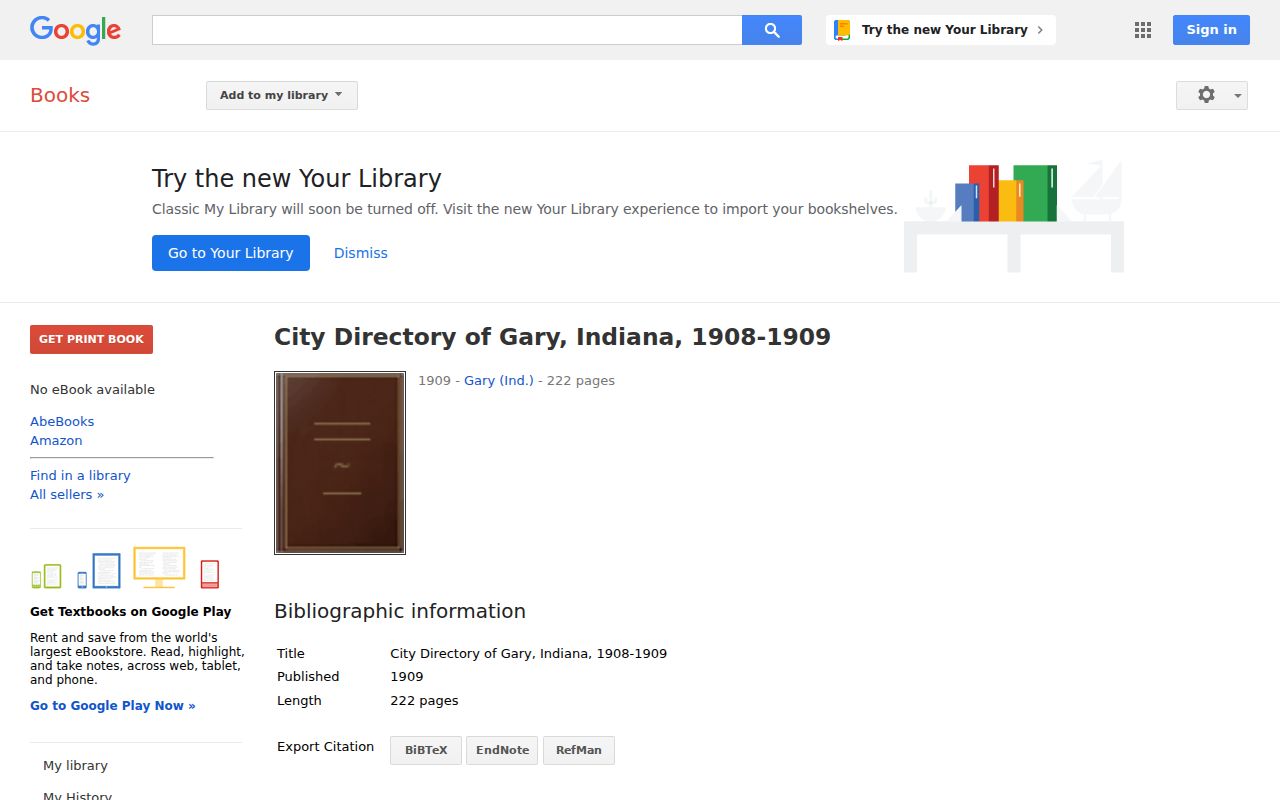
The Google Books catalog record confirms the title City Directory of Gary, Indiana, 1908-1909. During research, it did not expose a readable page image, alphabetic entry, street line, or abbreviation key. It is a strong catalog lead, not a digitized entry source.
View the 1908-1909 Gary directory record before using the captured catalog screen.
Gary's WPA Index Opens Side Trails
The Indiana Room's WPA Index spans 1906 through 1939 and was revised in 2017. Its headings include streets and names, neighborhood houses, wards, branches, organizations, and City Clerk or Council topics. A directory address can therefore lead to a clipping subject even when the surname index is thin.
Use the WPA item as a pointer. Then request the cited newspaper, clipping, or municipal material. The index is not a complete name roll, and a heading does not prove that a person lived at the place. It works best beside the library's newspapers on microfilm and Heritage Hub obituary or news searching.
Gary City Records Beyond Directories
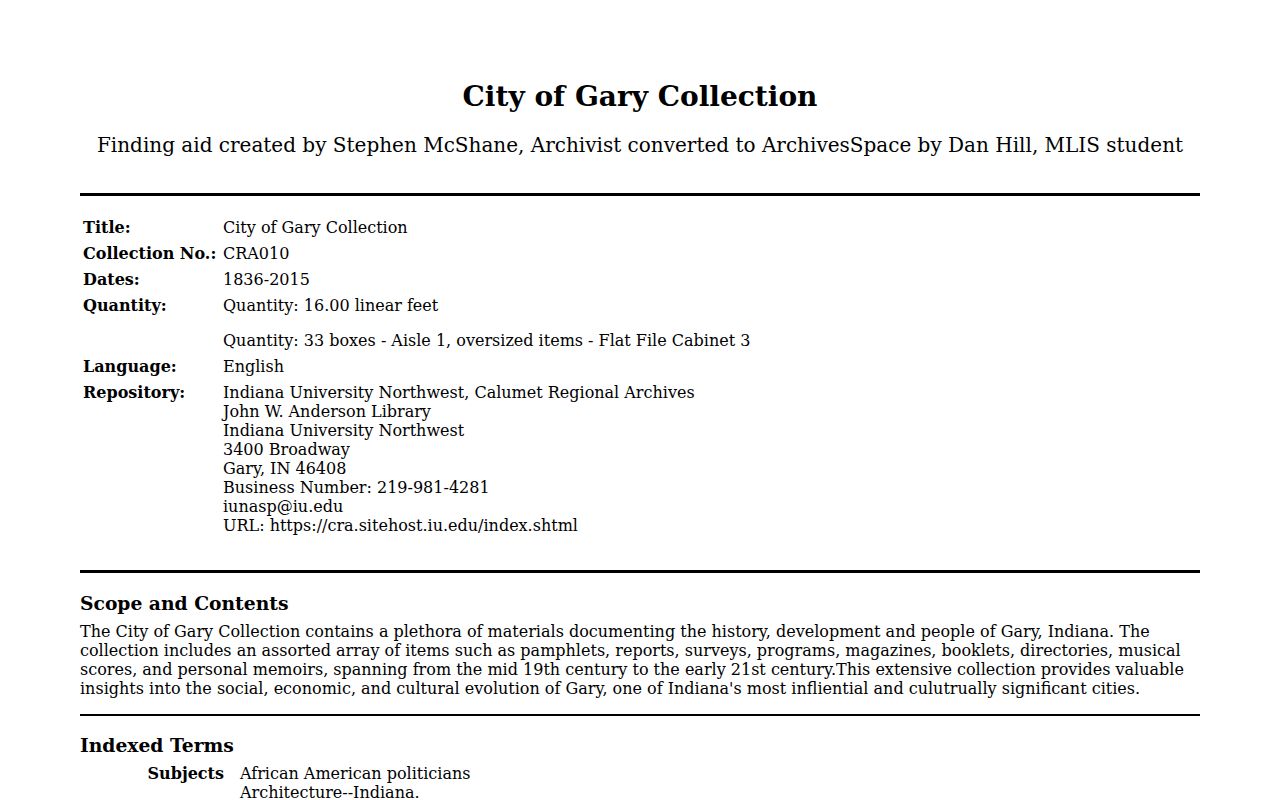
The IU Northwest City of Gary Collection, CRA010, spans 1836 through 2015 in 33 boxes totaling 16 linear feet. It includes reports, surveys, programs, magazines, pamphlets, booklets, directories, and memoirs. A finding aid can point to the right box, though it is not a complete online person index.
The regional archive also identifies CRA007 Lake County, CRA063 Gary Historical Society Records, CRA105 Lake County Public Records, CRA154 Gary Redevelopment Commission, CRA437 school enumeration, and CRA439 criminal court index cards. Collections cover Miller, churches, labor, Black history, ethnic communities, schools, and local government. Public access is allowed, but donor restrictions may affect some material.
Consult the CRA010 finding aid before reviewing the archive capture.
Map Gary Directory Addresses
Sanborn fire-insurance maps place a directory address on a physical block. The Indiana State Library Gary and Miller list includes 1907, 1908, 1911, 1915, 1917, a 1915-1951 run, a 1945 volume, and 1946-1949 volumes. The maps show building outline, material, use, stories, street width, property lines, and house or block numbers. They usually do not name residents.
Pair a map with the same-era directory. Then use the Indiana Room's microfilmed newspapers, obituary material, yearbooks, and Heritage Hub to test a move, death, school link, or community tie. A historical address that does not match today's form may need the 1915 city-engineer map or a Lake County atlas.
For modern ownership keyed by address, move to the Gary street directory workflow instead of reading current facts into an old volume.
Trace Families Through Gary Directories
A Gary directory works best as dated evidence in a longer chain. Begin with a volume close to a known event, copy the entry exactly, and keep a research log for every year checked, including years with no match.
- Find the surname and spelling variants in one confirmed Gary volume. Record the page, title, publisher, and year.
- Move to the nearest earlier and later holdings. Note street changes, initials, widow forms, and institutions.
- Read the volume's street section, or ask whether a verified criss-cross supplement exists, to test the address from the other direction.
- Pair the listing with the nearest released federal census. Public population schedules currently run through 1950 under the 72-year rule.
- Check a period map, newspaper, obituary, probate lead, or deed to explain a move or disappearance.
A missing entry can mean a move, death, omission, name change, publication gap, or different indexing practice. It does not prove what happened. Compare the same name, address, relatives, and dates across independent records before deciding two listings refer to one person.
Note: Cite the repository and call number with the year because Gary and State Library holdings do not match exactly.